
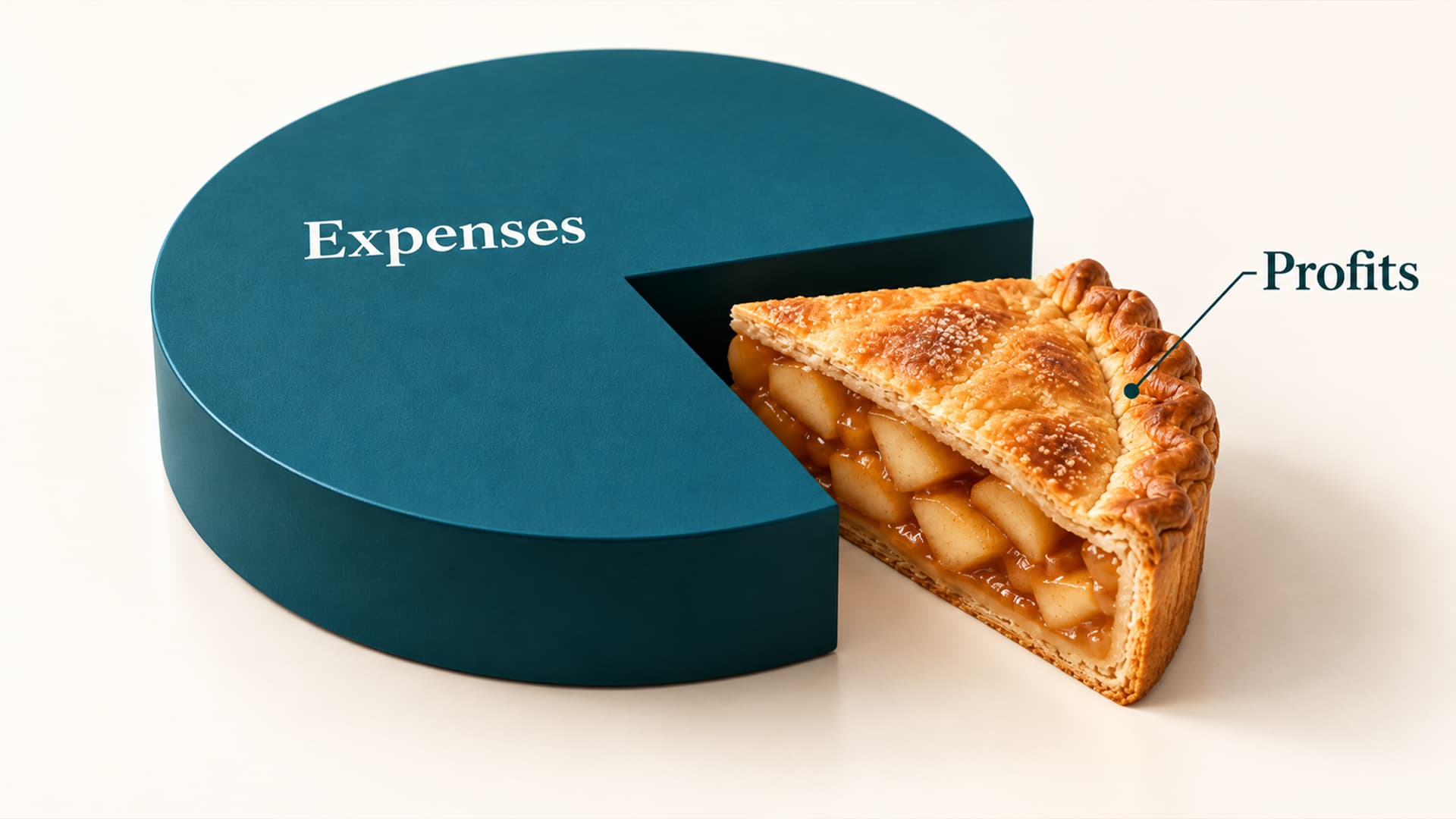
“When less money is available to run your business, you will find ways to get the same or better results with less. By taking your profit first, you will be forced to think smarter and innovate more.” (Mike Michalowicz)
Ask most small business owners how they manage money, and you’ll hear a version of the same formula: Sales minus Expenses equals Profit. It seems logical, but it also means profit is whatever happens to be left over, which is often nothing at all. This is the trap author and entrepreneur Mike Michalowicz set out to fix when he developed the Profit First system.
Rather than treating profit as a leftover, Profit First insists it be allocated immediately, before covering a single expense. The remaining money becomes the operating budget, forcing owners to run leaner, smarter businesses. It sounds backward, even risky. But for thousands of entrepreneurs who have adopted the method, it has proven to be less about restricting growth and more about revealing which expenses were never necessary in the first place.
Flipping the traditional accounting formula
Traditional accounting treats profit as a result: revenue comes in, bills go out, and whatever survives is profit. Michalowicz argues that this formula permits overspending, because expenses expand to consume whatever cash is available. His Profit First model reorders the equation so profit is subtracted first, and expenses are calculated from what remains. The logic doesn’t change the underlying math, but it does change behaviour. And behaviour, the maths shows, determines whether a small business survives.
The envelope system, modernised
At the heart of Profit First is a system of separate bank accounts, each representing a slice of incoming revenue: profit, owner’s compensation, taxes, and operating expenses. A fixed percentage of every rand that comes in is automatically allocated across these accounts, typically on a fortnightly basis. This is essentially the classic “envelope budgeting” method used by frugal households, but applied to a business’s income. Because the operating expenses account only ever contains a capped percentage of revenue, owners are structurally prevented from overspending. The money for extras simply isn’t there.
Cash crisis or growth problem?
Data on small businesses backs up the need for a different approach. The U.S. Bank famously found that 82 percent of small business failures are linked to cash flow problems, not lack of profitability on paper. Businesses can show a healthy income statement and still run out of cash, largely because expenses were allowed to grow unchecked while net cash flows sat as an afterthought. Profit First directly targets this mismatch by making cash flow, rather than projected profit, the operating discipline.
Constraint breeds innovation
One of the more counterintuitive claims of the Profit First philosophy is that constraint improves performance rather than limiting it. When less money is available to run the business, Michalowicz contends, owners are forced to find smarter and more efficient ways of operating instead of simply spending their way through problems. This mirrors a well-documented finding in behavioural economics known as Parkinson’s Law. This is the idea that spending, like work, expands to fill the resources available. By capping the funds available for expenses, Profit First deliberately triggers a search for efficiency that a bigger operating account would never demand.
But is it the right model for your business?
The model is not universally embraced. Some accountants and financial advisors argue that Profit First’s fixed percentage allocations can feel arbitrary for businesses with irregular revenue, seasonal cycles, or high fixed costs, such as manufacturers with heavy equipment financing. Critics also note that the system does not replace the need for a solid financial forecast or a real understanding of margins, it simply complements them. For businesses with wafer-thin margins, moving money into a profit account before covering costs can create short-term liquidity strain if it’s not paired with careful planning during the transition period. It is therefore vital that you speak to your accountant before making any changes.
Baby steps
Advisors who work with the method generally recommend a gradual rollout rather than an abrupt switch. Business owners are encouraged to start with modest allocation percentages, sometimes as low as 1 percent to a profit account, and increase them quarterly as the business adjusts to operating on a leaner expense base. The goal isn’t to starve the business overnight, but to build, in Michalowicz’s words, a habit rather than an event: small, consistent decisions that compound into structurally healthier finances over time.
The bigger behavioural shift
Perhaps the most lasting impact of Profit First isn’t the specific percentages or the number of bank accounts a business uses; it’s the shift in mindset it demands. Instead of asking “how much did we make?” at the end of a difficult year, owners are asking “how do we protect profit from the very first rand?” That single reframing turns expense control from a reactive, after-the-fact exercise into a proactive discipline built into the rhythm of the business. This may be exactly the kind of structural change your business needs.
Disclaimer: The information provided herein should not be used or relied on as professional advice. No liability can be accepted for any errors or omissions nor for any loss or damage arising from reliance upon any information herein. Always contact us for specific and detailed advice.
© AccountingDotNews